ads space

Showing posts with label balinese temple. Show all posts

Friday, March 2, 2012

Pura Rambut Siwi,a Tribute to Hindu Spreader Dang Hyang Nirartha


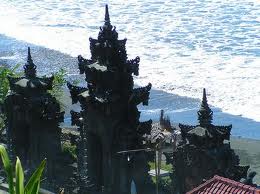
Pura Rambut Siwi so close to the sea
Rambut Siwi as a tourist attraction, is a neighborhood of a temple called Pura Rambutsiwi, surrounded by vast stretches of rice fields and terraces, to the south is a pile of cliffs and steep rocks. In addition to rice fields surrounded by terraces in the distance on the northern cluster of rustic look and the mountain range that stretches from west to east, and Ocean Indonesia to the south. In the southwest side of the temple there is a hall where we can take a break to enjoy the beautiful panorama of the sea, accompanied by the sound of waves crashing is pretty exciting. Not far from the hall, or South of Temple, there are steep to walk down to the beach. On the beach cliff there are two caves that are considered sacred and Kramat. The atmosphere in this place is very calm and good for calming the mind.

Descriptions

The History of Pura Rambut Siwi is closely connected with the sacred journey (dharma yatra) of Dang Hyang Nirartha in Bali in the XVI century.
After helping the people there of a problem, he was asked to settle there. But he could not and just give her hair as a replacement. Then the hair is respected as he,and was placed in the temple and is now called Hair Siwi or Rambut Siwi (Hair worship). Thus this temple has existed since the sixteenth century. If we look at the structure of this temple, not to deviate from the general structure of the temple in Bali. Temple is divided into three yards. Division of three pages may be linked to the division of the world into three parts, called Tri Loka, Bhur Loka  the (subconscious), Bhwah Loka the midle), and Swah Loka (the heaven).


steps to The Temple of Rambut Siwi

The Gate of Rambut Siwi

Location
Temple Rambut Siwi located in the seaside South West part of Bali island that is in the village of Yeh Embang Kangin, District Mendoyo, Jembrana. In the North of the temple more than 200 meters, lies the major highway Denpasar-Gilimanuk,where there is  penyawangan Pura Rambut Siwi. Here are usually if Hindus across the travel lane,they stopped to pray, to worship, and wish safety harness to the Almighty God. The distance from Denpasar city approximately 78 km, the journey there can be reached by car or motorbike. Can also get there by riding public transportation.  If a visitor using a motor bike , the vehicle can be parked directly near (east) the temple. Travel time from Denpasar city about 2 hours, and in the journey through of many winding roads, climbing up and down, so many natural beauty view seen along the way.

Facilities
Rambutsiwi has been supported by facilities and infrastructure, as is the availability of parking, public toilets, Wantilan Hall for a meeting place. On the edge of the highway in the north there are shops selling food and drinks. Around the temple compound (especially in the east and west) there are places to rest while releasing tired, looking at the beautiful natural surroundings. In addition there are also an exhibition of paintings and other souvenir items are on display every day.

Visitors
Rambutsiwi often received the visit of tourists, both domestic foreigners. The best time of the visit is on the afternoon before sunset. Generally, tourists visit there on all days, holidays and days of piodalan, the temple anniversary, once every 210 days. On this day,Many Balinese Hindus come to pray, carrying offerings, beseeching safety and happiness.


Friday, December 16, 2011

Balinese Sea Temples

Bali has a number of important sea temples which were founded in the 16th century by a Majapahit monk from Java named Nirartha to honour the gods of the sea . Each of the temples is traditionally said to be visible from the next, forming a 'chain' around the coast of Bali. Many of the most important sea temples are along the south west coast of the island. Listed counterclockwise from Nirartha's legendary point of arrival in Bali, some of the most prominent Balinese sea temples include:
  1. Pura Gede Perancak to the south of Negara 
  2. Pura Rambut Siwi to the east of Negara At this site Niratha is said to have made a gift of a lock of his hair, which was worshipped. Rambut Siwi translates as 'worship of the hair' and the tale is reminiscent of the Buddhist story of Gautama giving eight hairs to Tapussa and Bhallika, which are now enshrined at Shwedagon. 
  3. Pura Tanah Lot west of Canggu and south of Tabanan 
  4. Pura Luhur Uluwatu at the southwestern extremity of the Bukit Peninsula 
  5. Pura Mas Suka at the southern tip of the Bukit Peninsula, near Green Ball Beach. 
  6. Pura Sakenan at Pulau Serengan, an island between Benoa and Sanur 
  7. Pura Pulaki at Pulaki, northeast of Gilimanuk Pura Luhur Uluwatu is the only Balinese sea temple that is also one of the nine Balinese directional temples.

Pura Tanah Lot, A Temple with Famous Views


Tanah Lot means "Land [ in the] Sea" in Balinese language. Located in Tabanan, about 20 km from Denpasar, the temple sits on a large offshore rock which has been shaped continuously over the years by the ocean tide.

Tanah Lot is claimed to be the work of the 15th century priest Nirartha. During his travels along the south coast he saw the rock-island's beautiful setting and rested there. Some fishermen saw him, and bought him gifts. Nirartha then spent the night on the little island. Later he spoke to the fishermen and told them to build a shrine on the rock for he felt it to be a holy place to worship the Balinese sea gods.

The Tanah Lot temple was built and has been a part of Balinese mythology for centuries. The temple is one of seven sea temples around the Balinese coast. Each of the sea temples were established within eyesight of the next to form a chain along the south-western coast. However, the temple had significant Hindu influence.

At the base of the rocky island, poisonous sea snakes are believed to guard the temple from evil spirits and intruders. A giant snake purportedly protects the temple, which was created from Nirata’s scarf when he established the island.


In 1980 the temple’s rock face was starting to crumble and the area around and inside the temple started to become dangerous. The Japanese government then provided a loan to the Indonesia government of Rp 800 billion (approximately USD $130 million) to conserve the historic temple and other significant locations around Bali. As a result, over one third of Tanah Lot's "rock" is actually cleverly disguised artificial rock created during the Japanese-funded and supervised renovation and stabilization program.


The Famous Sunset over Tanah Lot from the Pan Pacific Nirwana Golf Resort

The area leading to Tanah Lot is highly commercialized and people are required to pay to enter the area. To reach the temple, visitors must walk through a carefully planned set of Balinese market-format souvenir shops which cover each side of the path down to the sea. On the mainland cliff tops, restaurants have also been provided for tourists.

Saturday, November 5, 2011

Pura Pusering Jagat,The Center of The Universe

Pura Pusering Jagat
Pura Pusering Jagat Banner
Just ask where the center of the world to the citizens of Pejeng Village, Gianyar,Bali, then deftly they would say that at Temple Pusering Jagat is the place. For those at Temple Pusering Jagat beginnings of life and civilization of the world. The conviction was most likely due to Pusering Jagat does mean center of the universe.

 Pura Pusering Jagat is an important temple in Bali. This temple is one of the six temples including the celestial universe is positioned in the middle. In Hindu cosmology, the middle is sthana (dwelling place) of Lord Shiva.

Main Gate of Pura Pusering Jagat
Kori Agung,The Gate

 Pusering Jagat Pura is located in the village Pejeng that in the past is central to the kingdom of Bali Kuna. Many believe that the word comes from the word "pajeng". Pajeng meaning umbrella. From this village the kings of Bali Kuna umbrella for people. However, there is also a suspect Pejeng word derived from the shelf (Old Javanese) which means light. It is believed, from where the rays emitted brilliance to the entire universe.

In ancient lontar(book),Pura Pusering Jagat also known as Tasik or central ocean. Naming it will remind people of the Hindu to the Adi Parwa which tells the story of the struggle of the Gods in seeking Amertha tirtha (water of life) in the middle of the ocean Ksirarnawa.

In this temple there are statues that show that this temple is a place of worship of Shiva as the statue of Ganesha (the son of Siva), Durga (Shiva magic), are also statues Bhairawa. There are also statues shaped male sex (purusa) and women (pradana). In Hinduism, Purusa and Pradana are God's first creation. Purusa is the psychological seeds, whereas seeds Pradana material. Purusa and Pradana this meeting gave birth to life and harmony.

Sangku Sudamala,Holy Vessel at Pura Pusering Jagat
Vessel Of  Sudamala

 In this temple there are also ancient relics shaped vessel called sangku Sudamala overflow symbolizing the holy water for life. Inside there are pictures sangku Sudamala digits indicating the year Saka 1251.

Friday, November 4, 2011

Pura Luhur Batukaru, Spirit of Life from The Jungle

The View on the Way to Pura Batukaru
The View Near Batukaru
 Pura Luhur Batukaru is a place of worship of God Mahadeva. Because of its function to worship God as The Power that grow the plants with water, then in the Pura Luhur Batukaru is referred to the worship of the Lord that also say as Hyang Tumuwuh - God as a foster.
God as the source of bring water to the soil so comes the power to grow the plants. Plants that will thrive with green leaves containing chlorophyll as a substance that saves lives. Worship of God in the Pura Luhur Batukaru should be the spiritual power of media to build a building on the spirit of life to seriously maintain soil fertility and water resources. With soil fertility maintained and protected water sources, then the plants will be fertile. Fertile plants that will continue if the air is not polluted by emissions of CO2. Contaminated air will cause acid rain which can damage the plants shoots. So the worship of God as Sang Hyang Tumuwuh have deep meaning for the life of mankind on this earth.
The existence of a conference on weather changes followed by 187 countries in Nusa Dua in 2007 is the moment to remind ourselves of the values ​​contained behind Sang Hyang Tumuwuh Worship at Temple Luhur Batukaru.

The Main Gate of Pura Batukaru
The Main Gate to Pura Batukaru
Pura Luhur Batukaru located in the village of Wongaya Gede,Penebel, Tabanan district in Bali. Location of the temple is located in the western part of Bali island on the southern slope of Mount Batukaru. Most likely the temple's name is taken from the name of this Batukaru Mt.
For those who want to pray to the Pura Luhur Batukaru is expected to pray at the Pura Taksu Jero temple,in order to proclamation that a prayer will go to pray in the Pura Luhur Batukaru and hope to get success during the process.
The Holy Shower
Holy Shower in Taman Beji
Then we must go to Taman Beji area,to headed shower. It is located in the southeastern part of the main temple but remain in the area of ​​Pura Luhur Batukaru.

Spring
Natural Spring Reservoir around Taman Beji
  The water fountain is to purify themselves by rinsing, washing face and wash the feet in the shower continued to pray in the temple Taman Beji as a sign of purification Sakala and Niskala or physical and spiritual as a key condition for worship can be done.

The Main Area of Pura Batukaru 
Main Area of Pura Batukaru
Pura Luhur Batukaru is also included in the Lontar (holy letter) called Dewa Kusuma. Pura Luhur Batukaru already exist in the 11th century AD,as old as Pura Besakih, Pura Luhur Lempuyang, Guwa Lawah Pura, Pura Luhur Uluwatu, and Pura Pusering Jagat. As the initiator of the establishment of the temple is Mpu Kuturan. Many experts view that the Mpu Kuturan establish Sad Kayangan to motivate people to maintain the balance of the existence of universe.
Pura Luhur Batukaru probably already be a place of worship and place of meditation by spiritual leaders in the area of ​​Tabanan and Bali in general. This opinion is based on the discovery of water sources and with different types of statues shower. From the sources of these springs can be concluded that the area was once used as a place for meditation. After the establishment of Pura Luhur Batukaru in the 11th century are we not getting a clear description of how the existence of the temple.

After in 1605 AD there is a description of the book Babad Buleleng. In the book explained that the Pura Luhur Batukaru was damaged by King of Buleleng named Gusti Ngurah Panji Sakti. In that chronicle book is told that the Buleleng Kingdom is very safe, no enemy would dare attack him. The King wanted to expand the empire, and reconciled to the expansion of Tabanan. Raja Ki Gusti Ngurah Panji Sakti on the way met with Batukaru area which is the kingdom of Tabanan area. Ki Gusti Ngurah Panji Sakti with his soldiers damaging Pura Luhur Batukaru. Temple was destroyed.
Outside of the calculation of Ki Panji Sakti suddenly came out of nowhere,a lot wasps and stinging them ferociously . Panji Sakti and its soldiers were attacked by wasps all-out fierce and venomous. Panji Sakti and scuttled back off and canceled a plan to attack the kingdom of Tabanan. Because the temple was damaged by Ki Panji Sakti then temple buildings were completely destroyed. Just left pile of rubble only.

In 1959 Pura Luhur Batukaru get repairs so the shape look like it is today. In 1977 in step by step there is attention of local government in aid. Until now Pura Luhur Batukaru situation is getting better.


Visitor in Pura Batukaru
Tourist Visit The Temple daily

Saturday, April 2, 2011

Pura Goa Lawah

Pura Goa Lawah is one which is considered the most sacred temple in Bali.

It's situated in the Pesinggahan village , District of Dawan, Klungkung regency, or approximately 49 kilometers from Denpasar. This temple is located to the left of the road to Padang Bai, or several miles before entering the area of Karangasem.


Goa Lawah means ‘bat cave‘ in Balinese, and in Bali, Goa lawah is a famous tourist attraction, as well as a place of religious importance to the Balinese people. The temple was founded in 1007, by Empu Kuteran. Though the temple is small, it is considered very auspicious and is one of the 9 kayangan jagat (directional temples)
that protect Bali from evil spirits. The temple at Goa Lawah protects Bali from the SE.
Balinese people often stop when driving along thius part of the coast, to give offerings. This is the case all over the island. On special days, raod side shrines may attract a large crowd of Balinese, dressed in ceremonial gear, stopping on their way to a major temple, to give offerings and pray. The parking area and souvenir sellers are in front of the temple, which itself is quite small. There is a 11 tier meru inside, donating its importance, but the actuall temple is quite small. It is possible to visit Goa Lawah during ceremonies, and I managed to get inside to watch people giving offerings and praying. The cave itself is in the rear of the temple, up against the cliff. Inside are hundreds of fruit bats and legend has it that the cave extends all the way underground Pura Goa, at Besakih temple 30 kms away. The cave is the dwelling of Balinese naga, Basuki. Bearing in mind the people at Tirtaganga believe the waters of the Ganges (in India) flow through there, I’d take that with a pinch of salt.

Pura Lempuyang,Temple of God Iswara

 In the various sources of ejection or ancient inscriptions, there are three large temples which are often called in addition to  Besakih  and Ulun Danu Batur, the temple Lempuyang. Pura Luhur Lempuyang located at the top of Mount Bisbis or Mount Lempuyang, Karangasem. This temple is  believed to  include  the oldest  in Bali. In fact, it is estimated  there  in the days of pre-Hindu-Buddhist shrine which was originally made ​​of stone. Pura Lempuyang is the temple for the god Iswara. How is the embryo of the founding of Temple Lempuyang?
There is an information based on shooting from outer space, on the eastern tip of Bali island appears very bright light. Most light than other parts. But not known for sure from where the beam area, it is suspected of Mount Lempuyang.
About the meaning of Lempuyang, there are various versions. In a book published by the Office of Culture of Bali (1998) entitled''Lempuyang Luhur''is mentioned," lempuyang" derived from the word''lampu''(=light) and "hyang" {meaning to refer to God, like Hyang Widhi). From that word  lempuyang interpreted holy light of God that brightly lit. Pura Hyang Lempuyang is "stana" of the god Iswara. 
Another legend say that Batara Hyang Pasupati sent three sons and daughters down to cuddle in order to maintain the stability of Bali from various natural disasters destruction. The three sons and daughter were the Bathara Hyang Putra Jaya  in Tohlangkir (Mount) Agung with the temple in Pura Besakih,   Goddess Dewi Danu in Ulun  Batur (lake Batur) and Batara Hyang Gni Jaya on Mount Lempuyang.

However, whatever version of lempuyang it, Pura Lempuyang itself has a very big status, just like Besakih. Both in concept Buwana padma, nutmeg or even chess workshops Gods Nawa sanga. In the various sources of ejection or ancient inscriptions, there are three large temples which are often referred besides Ulun Danu Batur Besakih and the Lempuyang.

Pura Luhur Lempuyang located very high on the top of Mount or Mount Lempuyang Bisbis that, allegedly including the oldest temple in Bali. In fact, it is estimated there in the days of pre-Hindu-Buddhist shrine which was originally made of stone.

At about 1950 on the establishment of Pura Luhur Lempuyang now, there were only piles of stones and the great studio made from a tree. In eastern  stood a big Sidhakarya tree which is now no allegedly fallen or dead. It was only in 1960 built two"padma Kembar", a "padma Tunggal" and Bale piyasan". Now, refurbishment and restoration of temples increased.

Acccording to a number of ancient sources, Jero Gede Mangku Wangi - stakeholders in the temple was - to say nothing of the Balinese must not forget this temple. At least once took pray to this temple. Because, if not ever forget to praise God or a manifestation  in this temple, as long as life can never find happiness, often quarreled with the family or community and even shorter life.

Jero Gede Mangku Wangi say, to start learning science, especially the Hindu religious science, very good if it starts to beg the blessing at Temple Lempuyang Luhur. In addition, many officials prefer come to this temple.


Jero Gede Mangku Wangi convey, at Temple Lempuyang Luhur  there are "Holy Water" in the bamboo tree which grows in the area Pura Luhur. When people praying here, stakeholders temple  would cut a bamboo tree after finish the praying. Holy water / tirta of the bamboo tree usually used in various ceremonies, except Manusa Yadnya. ''Whoever can not do bad as insipid in the temple, if you do not want to hit the distress,''said Jero Mangku.