ads space

Showing posts with label Pura Uluwatu. Show all posts

Friday, March 2, 2012

Pura Rambut Siwi,a Tribute to Hindu Spreader Dang Hyang Nirartha


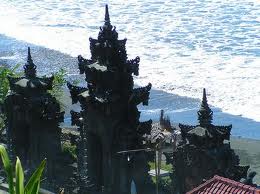
Pura Rambut Siwi so close to the sea
Rambut Siwi as a tourist attraction, is a neighborhood of a temple called Pura Rambutsiwi, surrounded by vast stretches of rice fields and terraces, to the south is a pile of cliffs and steep rocks. In addition to rice fields surrounded by terraces in the distance on the northern cluster of rustic look and the mountain range that stretches from west to east, and Ocean Indonesia to the south. In the southwest side of the temple there is a hall where we can take a break to enjoy the beautiful panorama of the sea, accompanied by the sound of waves crashing is pretty exciting. Not far from the hall, or South of Temple, there are steep to walk down to the beach. On the beach cliff there are two caves that are considered sacred and Kramat. The atmosphere in this place is very calm and good for calming the mind.

Descriptions

The History of Pura Rambut Siwi is closely connected with the sacred journey (dharma yatra) of Dang Hyang Nirartha in Bali in the XVI century.
After helping the people there of a problem, he was asked to settle there. But he could not and just give her hair as a replacement. Then the hair is respected as he,and was placed in the temple and is now called Hair Siwi or Rambut Siwi (Hair worship). Thus this temple has existed since the sixteenth century. If we look at the structure of this temple, not to deviate from the general structure of the temple in Bali. Temple is divided into three yards. Division of three pages may be linked to the division of the world into three parts, called Tri Loka, Bhur Loka  the (subconscious), Bhwah Loka the midle), and Swah Loka (the heaven).


steps to The Temple of Rambut Siwi

The Gate of Rambut Siwi

Location
Temple Rambut Siwi located in the seaside South West part of Bali island that is in the village of Yeh Embang Kangin, District Mendoyo, Jembrana. In the North of the temple more than 200 meters, lies the major highway Denpasar-Gilimanuk,where there is  penyawangan Pura Rambut Siwi. Here are usually if Hindus across the travel lane,they stopped to pray, to worship, and wish safety harness to the Almighty God. The distance from Denpasar city approximately 78 km, the journey there can be reached by car or motorbike. Can also get there by riding public transportation.  If a visitor using a motor bike , the vehicle can be parked directly near (east) the temple. Travel time from Denpasar city about 2 hours, and in the journey through of many winding roads, climbing up and down, so many natural beauty view seen along the way.

Facilities
Rambutsiwi has been supported by facilities and infrastructure, as is the availability of parking, public toilets, Wantilan Hall for a meeting place. On the edge of the highway in the north there are shops selling food and drinks. Around the temple compound (especially in the east and west) there are places to rest while releasing tired, looking at the beautiful natural surroundings. In addition there are also an exhibition of paintings and other souvenir items are on display every day.

Visitors
Rambutsiwi often received the visit of tourists, both domestic foreigners. The best time of the visit is on the afternoon before sunset. Generally, tourists visit there on all days, holidays and days of piodalan, the temple anniversary, once every 210 days. On this day,Many Balinese Hindus come to pray, carrying offerings, beseeching safety and happiness.


Tuesday, November 8, 2011

Clean Your Body and Purify Your Nind at Pura Tirta Empil


More than a thousand years ago a powerful King named Mayadenawa ruled over a vast area which included Bali. Mayadenawa possessed the spiritual power to transform himself into anything he desired. Unfortunately he misused his powers and became a cruel, black magician.
A priest named Sang Kulputih appealed to Indra to come to earth to kill Mayadenawa.Because he had many spies, Mayadenawa learned about the upcoming attack in time and managed to organize his defenses. However Lord Indra's forces were superior and therefore victorious. Most of King Mayadenawa troops fled, leaving him almost without defense.
Then the war was interrupted by nightfall. When Indra's forces slept, Mayadenawa stole into Indra's camp, walking on the sides of his feet as to leave no foot prints, and created a pool of poisoned water. This way of walking gave Tampaksiring its name, for tampak siring is Balinese for 'without imprints'. He left as he came and when Indra's forces woke up the next morning and discovered the water pool, they drank from it and became violently sick.
When Indra found out what happened, he created a large spring of fresh water by stabbing his flag pole to the ground.The clear water was able to cure the sickness of his army. The spring was called Tirtha Empul, which means bubbling spring.
Mayadenawa fled, chased by the forces of Indra. During his flight he transformed himself a number of times, but he couldn't trick Indra with his disguises. When he had transformed himself into a stone, he was shot by Indra with an arrow. A stream of blood flowed from the stone, forming the river Petanu. And for a thousand years this river would be cursed. Rice fields irrigated with its water would make the rice grow fast, but once harvested, blood would come out of it and it would smell bad.
The death of King Mayadenawa is symbolic for the victory of good (dharma) over evil (adharma). The day of Mayadenawa's death is still celebrated, every 210 days according to the Balinese Pawukon calendar, and this day is generally known as Galungan Day


Pura Tirta Empul is a water temple in Bali, located about 12 miles northeast of Ubud. Fed continuously by springs, the Balinese consider the water holy and believe it comes from sacred Lake Batur, atop volcanic Mt. Batur. After it passes through the temple complex, the water feeds the Pakerisan River and many of the subaks to the south around Ubud.
At the center of the temple complex is the spring source, held within a large walled pool. The cool spring water bubbles out of dark grey volcanic sand, which billows under water among electric green freshwater algae and ferns.


Underground channels direct water from the spring pool into the four blessing pools where it spurts from cylindrical stone spouts. The four blessing pools are aligned laterally at the base of the spring pool. The first pool, at the left, has 13 spouts. To receive blessings, a worshipper steps down into the water, submerged to 85 cm, and walks across the stone bottom to the spout on the left. Proceeding from left to right the worshipper repeatedly bows to submerge head and shoulders under the water from each spout, offering prayers and receiving blessings. There are spouts for baby ceremonies, spouts for nightmares, and spouts for holy water to take away.
The spring water passes in underground channels from the blessing pools to the public washing pools and then enters the river to feed the rice terraces to the south.

Sunday, April 3, 2011

The Amazing of Pura Luhur Uluwatu


Luhur Uluwatu Temple or Pura Uluwatu temple is located in the region Pecatu Village, Kuta District, Badung.

The Temple is located at the southwestern tip of Bali island over the stone bridge and a high cliff jutting into the sea and this is one of the "Sad Khayangan" which is believed by Hindus as a buffer from 9 of the wind. This temple was originally used to be a place to worship a holy priest of the 11th century named Empu Kuturan. He lowered the teachings of Indigenous Village with all the rules. This temple is also used to worship the holy priest that followed, namely Dang Hyang Nirartha, who came to Bali in late 1550 and end the journey with  Moksah in this place.


Uluwatu Temple is situated at an altitude of 1997 meters above sea level. In front of the temple there is a small forest called kekeran forest, serves as a support of the sanctity of the temple.Pura Uluwatu  has several parts of temples, which are closely associated with temples temples parent. They are Pura pesanakan Bajurit,Pura Pererepan , Pura Kulat, Pura Dalem Pangleburan Selonding and Pura Dalem. Each temple has close links with the Pura Uluwatu, especially in the days of temple Celebration that called piodalan . Piodalan at Pura Uluwatu  fell on Tuesday Kliwon Wuku Medangsia every 210 days. Manifestation of God who was worshiped in the Pura Uluwatu is the God Rudra.  Uluwatu Temple became famous for his right under it is a beach Pecatu often used as a place to surf, and even international events are often held here. This beach is very famous waves suitable for surfing to be a place other than the natural beauty of Bali is indeed very beautiful.